
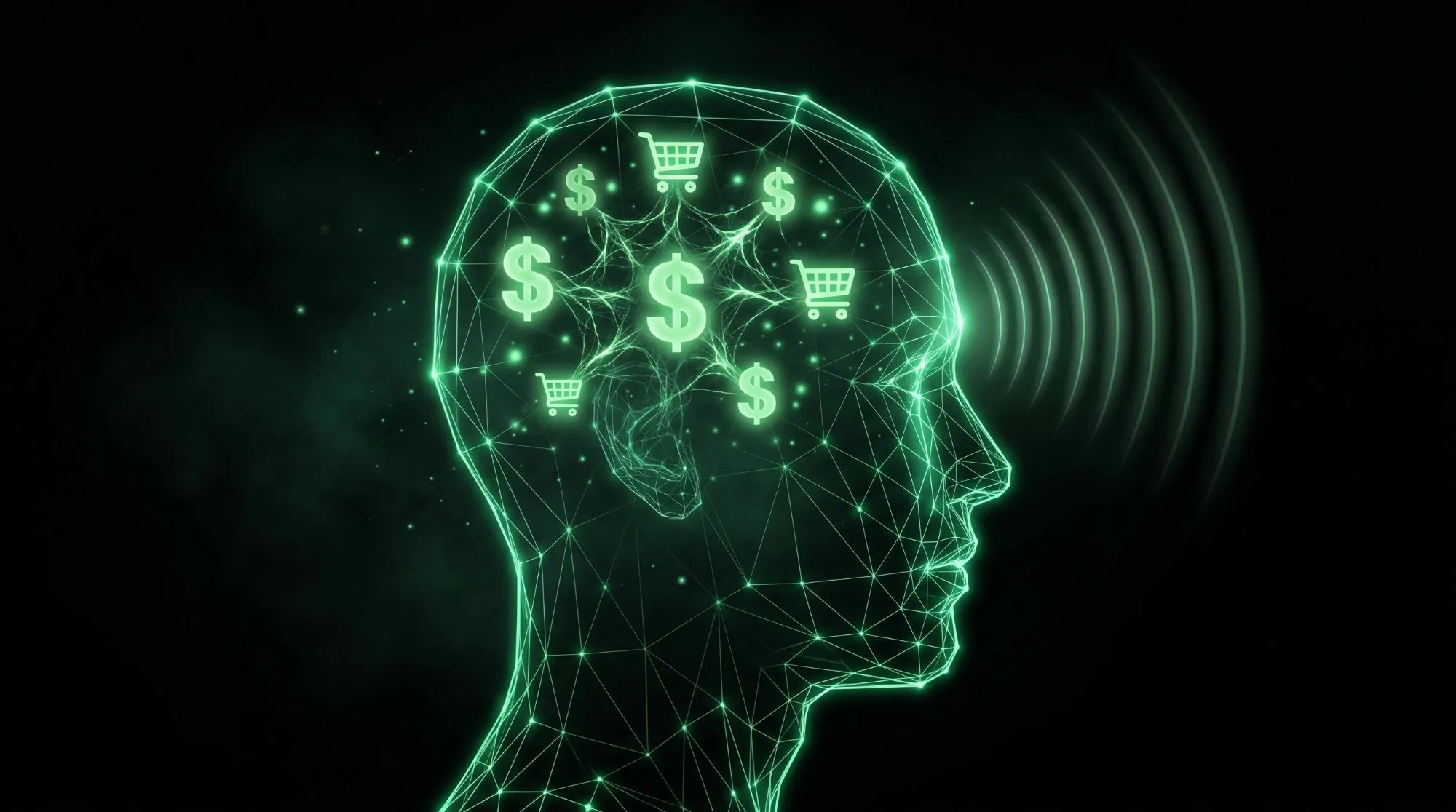
Why You Overspend: The Psychology Behind Every Purchase You Regret
Your Brain Is Working Against Your Wallet
You overspend because your brain is wired for immediate gratification, not long-term financial planning. Dopamine reward pathways, present bias, social comparison, and emotional triggers create automatic spending patterns that operate below conscious awareness. The problem is not a lack of discipline — it is neuroscience working against your wallet.
Every time you overspend, it feels like a choice. It is not. Decades of behavioral research show that spending decisions are driven by unconscious patterns — emotional triggers, cognitive biases, and environmental cues that bypass your rational mind entirely.
Understanding these patterns is the first step to changing them. Not through willpower (which fails 92% of the time), but through awareness at the exact right moment.
The 5 Psychological Triggers Behind Overspending
1. Dopamine Anticipation — The Shopping High
Your brain releases dopamine not when you receive something, but when you anticipate receiving it. This is why browsing online stores feels exciting — and why the item feels disappointing after it arrives. The pleasure was in the wanting, not the having.
The pattern: You feel a rush while adding items to cart. The moment you complete checkout, the dopamine drops. You chase the next purchase to recreate the feeling.
2. Mental Accounting — Money in Buckets
Nobel laureate Richard Thaler discovered that people treat money differently depending on its source. A $100 bonus gets spent frivolously, while $100 from your salary feels precious — even though both are identical. This is why "found money" (tax refunds, cashback, bonuses) disappears instantly.
3. The Anchoring Effect — Price Is Relative
When you see a $200 jacket marked down to $120, your brain processes it as "saving $80" rather than "spending $120." The original price serves as an anchor that makes any lower number feel like a deal — even if $120 is more than you should spend on a jacket.
4. Social Comparison — Keeping Up
Humans are wired to compare. When your colleague gets a new car or your friend posts a vacation, your brain registers a status gap. Spending becomes an attempt to close that gap — not because you need the item, but because you need the feeling of equality.
5. Stress Response — Emotional Spending
Cortisol (stress hormone) impairs prefrontal cortex function — the part of your brain responsible for long-term planning and impulse control. This is why you make your worst financial decisions when stressed, tired, or emotionally drained. It is not weakness; it is biology.
Why Willpower Alone Does Not Work
The traditional advice is simple: "Just stop spending so much." This is like telling someone with insomnia to "just sleep." The problem is not knowledge — it is behavior.
Willpower is a depletable resource. By evening, after a full day of decisions, your willpower is at its lowest. This is exactly when most impulse purchases happen — late at night, scrolling your phone, tired and stressed.
The solution is not more willpower. It is behavioral intervention at the right moment — a system that detects when you are on autopilot and creates a moment of awareness before the purchase happens.
How Behavioral Awareness Changes Everything
Research from Duke University shows that 45% of daily actions are habitual — performed without conscious thought. Spending is no different. Most purchases are not decisions; they are patterns.
The key to change is not information. You already know you should spend less. The key is awareness at the point of action — a mirror held up at the exact moment you are about to repeat a pattern.
This is the principle behind SpendTrak. It does not tell you what to do. It does not lecture or advise. It observes your patterns silently, and at the precise behavioral moment — when you are about to repeat a spending pattern on autopilot — it shows you yourself. One message. No judgment. Just a mirror.
And that moment of awareness is enough. Because once you see the pattern, you cannot unsee it. The autopilot breaks. The choice returns to you.
Frequently Asked Questions
Overspending beyond your means is typically driven by a combination of present bias (valuing immediate gratification over future consequences), social comparison, and emotional regulation through purchases. Your brain processes 'future you paying the bill' as a different person entirely.
While not classified as a clinical addiction in most frameworks, compulsive spending activates the same dopamine reward pathways as other addictive behaviors. The pattern of anticipation, action, brief satisfaction, and regret mirrors addiction cycles closely.
The most effective approach is not restriction but awareness. Track your spending patterns to identify triggers (time of day, emotional state, specific environments), then create friction at those specific moments. Apps like SpendTrak automate this by detecting your patterns and intervening at the right moment.
Stop Tracking. Start Changing.
SpendTrak uses behavioral AI to detect your spending patterns and intervene at the right moment. Not advice. Not judgment. Just a mirror.

Overspending is not classified as a standalone mental disorder, but compulsive spending can be a symptom of conditions like bipolar disorder, ADHD, anxiety, and depression. When spending becomes uncontrollable and causes significant financial distress, it may indicate an underlying condition worth exploring with a mental health professional.
Yes, overspending can be a trauma response. People who experienced financial scarcity, emotional neglect, or instability may use spending to feel safe, in control, or worthy. The dopamine from purchases provides temporary relief that mirrors what was missing during the traumatic experience.
Part of the SpendTrak Spending Psychology Library
Read the Complete Spending Psychology Guide →